

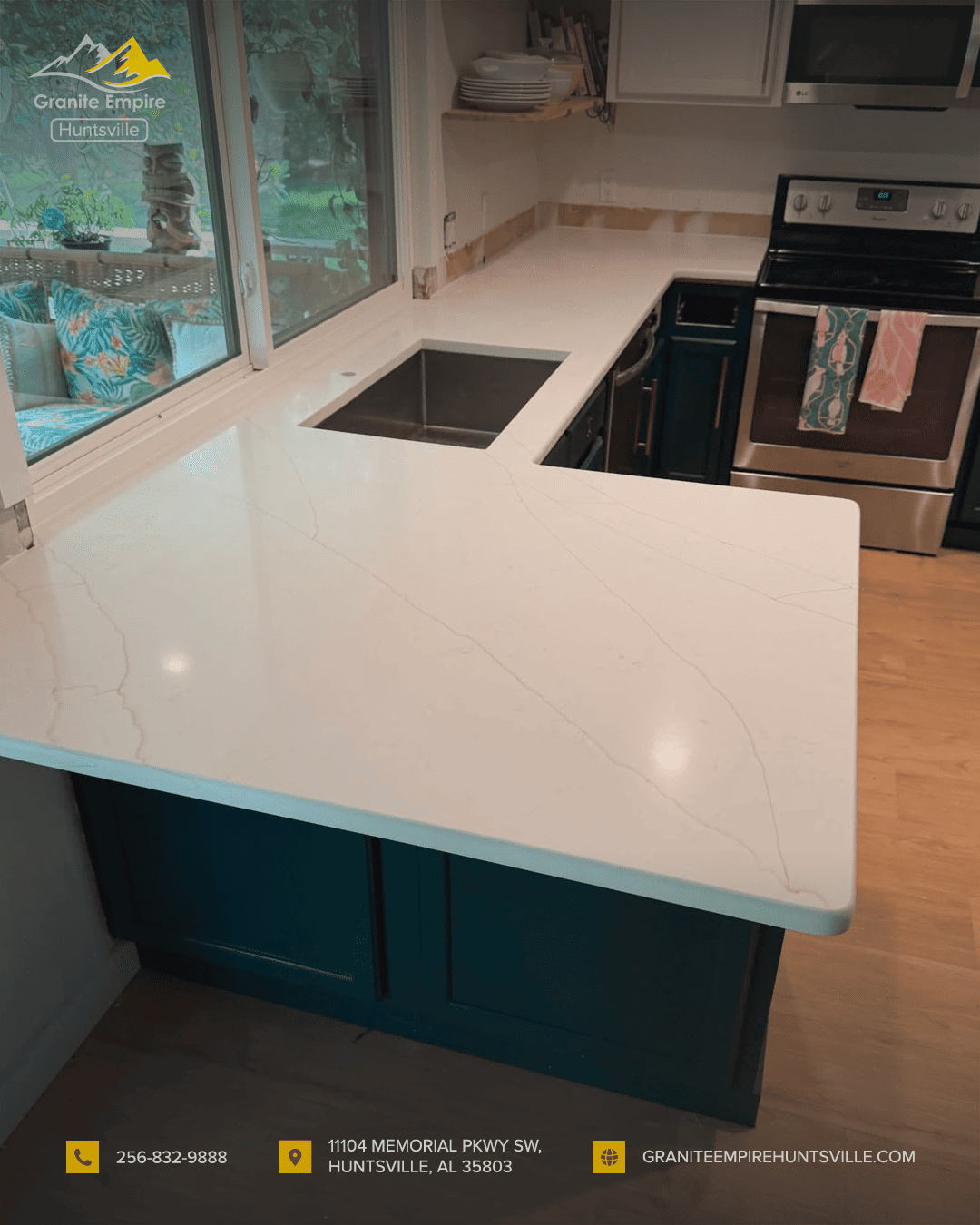
This is one of the most common questions we get from homeowners considering white quartz, and it deserves a direct, honest answer rather than a reassuring non-answer. Yes, some white quartz countertops can yellow over time — but whether yours will depends almost entirely on the brand you choose, the quality of the resins used in manufacturing, and how the surface is maintained. With the right product and proper care, yellowing is not an inevitable outcome.
At Granite Empire of Huntsville, we work with quartz regularly and have seen how different products perform over time in real kitchen environments. Our showroom and fabrication facility are in Huntsville, AL — that is our only location. We serve homeowners from Sheffield, AL and throughout the Tennessee Valley region from our single Huntsville facility, and we have no office or showroom in Sheffield. Here is everything you need to know about quartz countertops in Sheffield, AL and the yellowing question before making a purchasing decision.

Why Do Some White Quartz Countertops Yellow?
The yellowing that occurs in some white quartz countertops is caused primarily by UV light degradation of the polymer resins that bind the quartz crystals together. Quartz is an engineered material — roughly 90 to 95 percent natural quartz crystals held together with resin binders and pigments — and the quality of those resins varies significantly between manufacturers. Lower-quality resins are more susceptible to photochemical breakdown when exposed to sunlight over time, and that breakdown shows up as a yellowish or amber tint in what was originally a bright white surface.
This is most pronounced in kitchens with large windows, skylights, or significant direct sunlight exposure. In a kitchen with limited natural light, UV degradation is less of a concern — but it doesn’t disappear entirely because some artificial lighting sources also emit UV. The issue is real, it’s documented, and it’s one of the primary reasons brand selection matters so much when choosing white quartz countertops in Sheffield, AL.
Secondary causes of yellowing include chemical reactions from certain cleaning products — particularly bleach-based and strongly alkaline cleaners — that can react with the resin binders and discolor the surface over time. Some food and beverage stains, if left in prolonged contact with the surface, can also contribute to surface discoloration in lower-quality products.
Which Quartz Brands Are Most Resistant to Yellowing?
The brands with the strongest track record for resisting UV yellowing in white collections are Cambria, Silestone, and Caesarstone. All three use high-quality resin formulations with UV inhibitors built into the manufacturing process, and all three back their products with substantial warranties that address manufacturing defects including discoloration.
Cambria is an American-made quartz manufacturer with one of the strongest reputations for color stability in white collections. Their Quartz White Cliff, Brittanicca, and Ella collections have performed consistently well in high-sun kitchen environments and are among the white quartz options we most confidently recommend at Granite Empire of Huntsville. Cambria’s lifetime warranty covers manufacturing defects including color changes under normal use conditions.
Silestone’s Eternal White and White Zeus collections use Silestone’s proprietary N-Boost technology, which the company states enhances surface resistance and color stability. The Eternal series specifically was developed with UV resistance as a design priority, making it a strong choice for kitchens with significant natural light exposure. Caesarstone’s Organic White and Sleek Concrete collections are also reliable performers on color stability.
MSI Q Premium Natural Quartz offers white collections at a more accessible price point — typically $85 to $120 per square foot installed — and performs reasonably well on color stability in normal conditions. For kitchens with very high sun exposure, however, we’d lean toward the premium brands whose UV resistance claims are more thoroughly documented.
Does Quartz Manufacturer Warranty Cover Yellowing?
Premium brand warranties do cover manufacturing defects, which can include yellowing that occurs under normal use conditions. However, the distinction between manufacturing defect and improper maintenance or misuse is important to understand before relying on warranty coverage.
Cambria’s lifetime warranty is one of the most comprehensive in the industry and covers defects in manufacturing. Caesarstone offers a lifetime limited warranty for residential installations. Silestone offers a 25-year warranty on residential installations. All of these warranties require that the product be installed by an authorized dealer, used under normal residential conditions, and maintained according to manufacturer guidelines — which means avoiding the harsh cleaning products that can contribute to discoloration.
For homeowners investing in quartz countertops in Sheffield, AL, choosing a brand with a strong, clearly documented warranty is part of the value calculation — not just a marketing consideration. If color stability issues do develop on a warranted product used correctly, the warranty provides a real mechanism for resolution.
What Maintenance Practices Affect the Risk of Yellowing?
Cleaning product selection is the maintenance factor most directly linked to yellowing risk. Bleach-based cleaners, strongly alkaline degreasers, and harsh chemical cleaners can react with quartz resin binders and accelerate surface discoloration over time. This applies even to premium brand products — the resin chemistry that makes quartz durable also makes it reactive to certain chemical exposures.
Mild dish soap and warm water is the safest and most effective daily cleaning routine for white quartz. For tougher cleaning needs, a mild pH-neutral stone cleaner is appropriate. Avoid products with bleach, ammonia, or high alkalinity, and always rinse the surface thoroughly after any cleaning product application.
Prolonged contact with staining substances — turmeric, red wine, coffee, certain cooking oils — can also contribute to surface discoloration over time if spills are not wiped up promptly. White quartz is non-porous and won’t absorb these substances the way natural stone would, but surface-level discoloration from extended contact with strong pigments is possible and more visible on a white surface than on any other color.
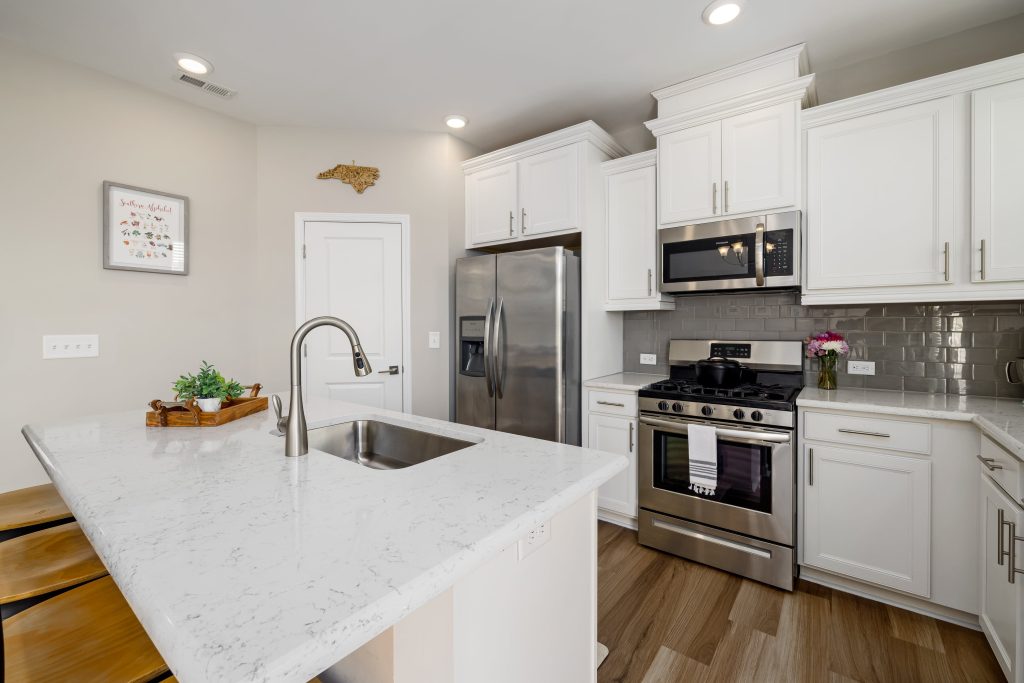
How Does White Quartz Compare to White Granite and White Marble on Color Stability?
This comparison looks specifically at color stability over time — a different lens than the standard durability comparison.
| Material | UV Yellowing Risk | Chemical Discoloration Risk | Stain Absorption Risk | Color Stability Rating | Maintenance for Color |
|---|---|---|---|---|---|
| Premium White Quartz | Low (with quality brand) | Low – Medium | Very Low | Very Good | Gentle cleaners only |
| Budget White Quartz | Medium – High | Medium | Very Low | Fair | Gentle cleaners, avoid sun |
| White Granite | Very Low | Very Low | Low (when sealed) | Excellent | Periodic sealing |
| White Marble | Very Low | High (acid etching) | Medium (when unsealed) | Good – Variable | Frequent sealing, acid avoidance |
| White Quartzite | Very Low | Very Low | Low (when sealed) | Excellent | Periodic sealing |
Natural stone materials — granite, marble, quartzite — don’t contain polymer resins and are therefore not subject to UV-induced yellowing. Their color stability comes from the geological composition of the stone itself, which doesn’t degrade photochemically. This is a genuine advantage of natural stone over engineered surfaces in high-sun kitchen environments, and it’s worth factoring into the decision for homeowners with east- or south-facing kitchens with significant window exposure.
White granite selections like Bianco Romano, White Ice, and River White offer excellent color stability at $95 to $150 per square foot installed. White quartzite — Super White and similar selections — delivers exceptional color stability with a visual character that’s more compelling than granite for many homeowners, at $110 to $180 per square foot installed. For homeowners specifically concerned about yellowing in a sun-heavy kitchen, natural stone alternatives are worth a direct conversation.
What Is the Real-World Risk of Yellowing With a Quality Quartz Brand?
With a premium brand product — Cambria, Silestone, Caesarstone — properly installed and maintained with appropriate cleaning products, the real-world risk of significant yellowing under normal residential conditions is low. These manufacturers have invested substantially in resin formulation and UV resistance technology, and their warranty terms reflect a genuine commitment to color stability.
The risk increases meaningfully with lower-tier or unbranded quartz products, with very high direct sun exposure, and with cleaning routines that include bleach-based products. At Granite Empire of Huntsville, we’re direct with every customer considering white quartz countertops in Sheffield, AL: the brand choice matters significantly more for white quartz than for any other color, and investing in a quality brand is the most reliable insurance against yellowing.
The price premium for a quality brand over a budget quartz product on a standard kitchen project is typically $1,000 to $2,500 — a meaningful but not dramatic difference when spread across the expected lifespan of the installation.
What Is the Timeline for Quartz Countertop Projects?
At Granite Empire of Huntsville, the standard timeline from completed template appointment to installed quartz countertops is 5 to 7 business days, covering full fabrication — cutting, edge profiling, all cutouts, and finishing — plus installation scheduling.
The template appointment happens 2 to 3 business days after cabinets are confirmed fully installed and leveled and the slab selection is reserved in our Huntsville, AL facility. From first showroom visit to quartz countertops in Sheffield, AL fully installed, total project time runs 10 to 14 business days when the homeowner’s side is ready to proceed. Cabinet readiness is consistently the most common source of delay.
We have no location in Sheffield — Granite Empire of Huntsville operates exclusively from our Huntsville, AL facility. Customers from Sheffield are welcome at our showroom to see the full quartz collection inventory across all brands and price tiers in person. Visit us at 11104 Memorial Pkwy SW, Huntsville, AL 35803, or call 256-832-9888 to schedule a showroom visit or discuss your project.
Frequently Asked Questions
Do all white quartz countertops yellow over time?
No — but the risk varies significantly by brand and resin quality. Premium brands like Cambria, Silestone, and Caesarstone use UV-resistant resin formulations that perform well in normal residential conditions. Budget or unbranded quartz products carry a meaningfully higher yellowing risk, particularly in sun-exposed kitchens.
What causes white quartz to yellow?
The primary cause is UV degradation of the polymer resins that bind the quartz crystals. Secondary causes include chemical reactions from bleach-based or strongly alkaline cleaning products and prolonged surface contact with strongly pigmented substances.
Which white quartz brands have the best color stability?
Cambria, Silestone, and Caesarstone have the strongest documented track records for color stability in white collections. Cambria’s Quartz White Cliff and Brittanicca, Silestone’s Eternal White, and Caesarstone’s Organic White are among the most consistently recommended options at Granite Empire of Huntsville.
What is the installed cost of quartz countertops in Sheffield, AL in 2026?
Standard quartz collections run $85 to $130 per square foot installed. Premium brand collections reach $120 to $180 per square foot installed. For a standard kitchen with 50 to 60 square feet, total project cost runs $4,250 to $10,800. Most mid-range projects at Granite Empire of Huntsville land between $5,500 and $8,500 fully installed.
How long does fabrication and installation take?
At Granite Empire of Huntsville, the timeline from completed template to installation is 5 to 7 business days. Total project time from first showroom visit to installed quartz countertops is 10 to 14 business days when cabinets are fully ready.
Does Granite Empire of Huntsville have a location in Sheffield, AL?
No. Our only location is 11104 Memorial Pkwy SW, Huntsville, AL 35803. We serve Sheffield and the Tennessee Valley region from that single Huntsville facility with no office or showroom in Sheffield.
How do I get started on a quartz countertop project?
Call us at 256-832-9888 or visit our showroom at 11104 Memorial Pkwy SW, Huntsville, AL 35803. We recommend coming in person to see the full white quartz selection across all brands — the difference in color quality and surface character between budget and premium collections is most clearly understood when you’re comparing them side by side.