

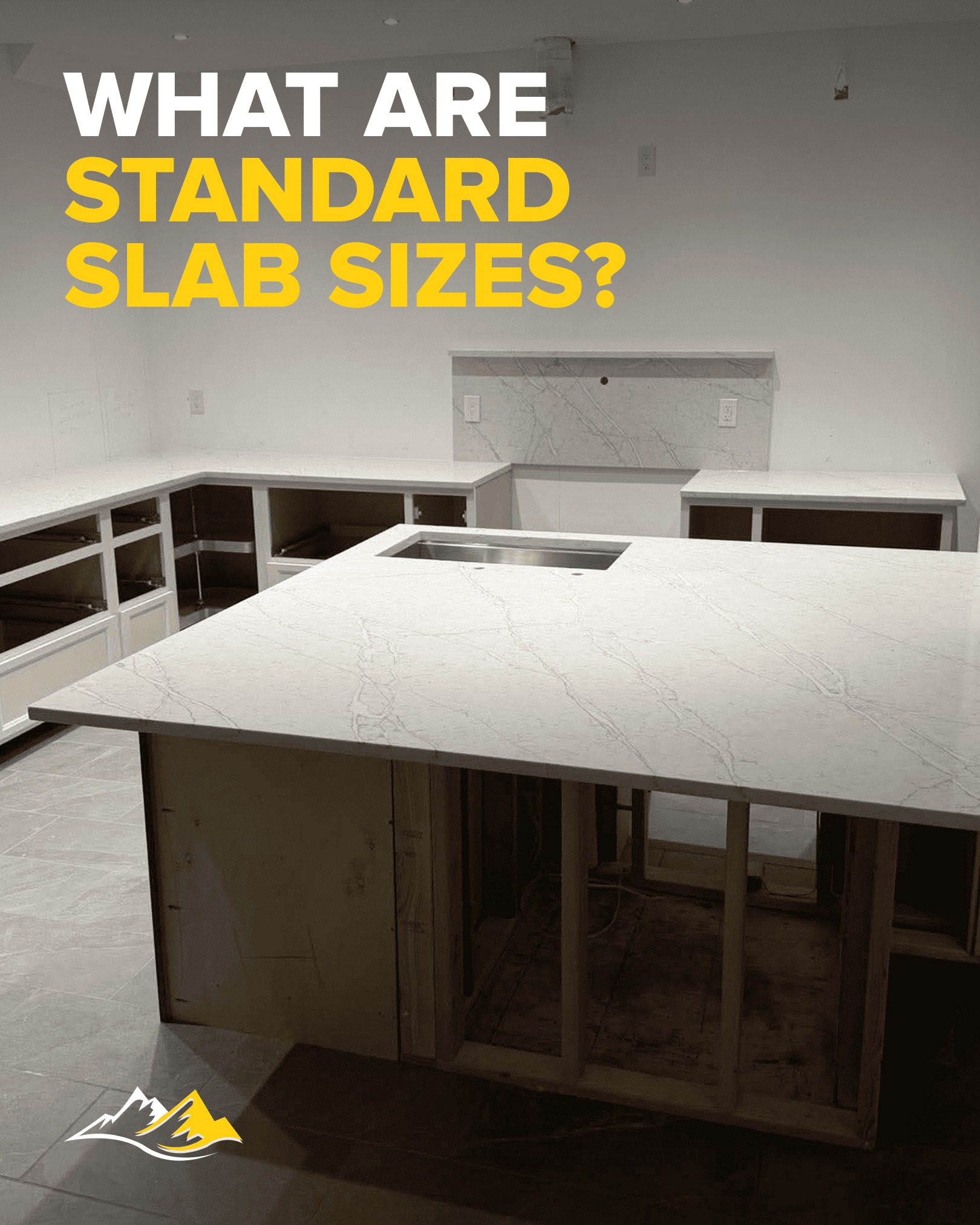
We get this question fairly often from homeowners trying to plan a layout before ever stepping foot in a showroom, and it’s a smart question to ask early. Slab size affects seam placement, waste, and ultimately cost in ways that aren’t always obvious until you’re deep into planning. As countertop fabricators in Moulton, AL and throughout the Huntsville area rely on for both material sourcing and installation, here’s the real talk on slab dimensions and what they mean for your project.

What Are the Standard Dimensions for a Granite Slab?
Most granite slabs run roughly 9 to 10 feet long and 5 to 6 feet wide, though exact dimensions vary by quarry and specific stone. This is the range we typically work with when planning layouts for kitchen islands, peninsulas, and countertop runs.
Some premium or imported stones come in slightly different sizes depending on the block they’re cut from, which is one reason we always confirm exact dimensions before finalizing a layout. Countertop fabricators in Moulton, AL clients working on larger kitchens should know this range going in, since it directly affects how many pieces a layout will require.
Does Slab Size Affect How Many Seams My Kitchen Will Have?
Yes, slab size directly determines seam placement, since a countertop run longer than the slab itself requires an additional piece and a seam to join them. This is one of the most practical planning considerations before ordering.
A standard 9 to 10 foot slab can often cover an entire kitchen wall run without a seam, but larger islands or L-shaped layouts frequently need at least one seam regardless of slab size. We map this out during the design phase so countertop fabricators in Moulton, AL clients know exactly what to expect before fabrication begins.
Are Quartz Slabs the Same Size as Granite?
Not exactly, quartz slabs tend to run slightly larger on average, often up to 10 to 11 feet in some collections, since they’re manufactured rather than quarried in nature. This gives slightly more flexibility on certain layouts compared to natural stone.
Collections like Cambria and Silestone offer some jumbo slab options specifically designed to minimize seams on larger kitchen islands. Countertop fabricators in Moulton, AL projects using quartz sometimes benefit from these larger format options when seam-free runs matter most to the homeowner.
Can You Get a Custom Slab Size for a Larger Kitchen?
No, slab size itself can’t be custom-ordered beyond what’s naturally quarried or manufactured, but layouts can be planned around available slab dimensions to minimize seams as much as possible. This is where experienced fabrication planning really matters.
We work with the natural size limitations of each material to design a layout that uses seams strategically, placing them in less visible areas like behind a sink or along a natural break point. This kind of planning is a core part of what countertop fabricators in Moulton, AL rely on us for during the design consultation.
Granite vs. Quartz vs. Marble: How Do Slab Sizes Compare?
Quartz generally offers the largest standard slab sizes, granite falls in a similar but slightly smaller natural range, and marble sizes vary more due to its quarrying process. Here’s how the three compare on typical dimensions.
| Factor | Granite | Quartz | Marble |
|---|---|---|---|
| Typical length | 9-10 feet | 10-11 feet (jumbo options available) | 8-10 feet, varies by quarry |
| Typical width | 5-6 feet | 5-6.5 feet | 5-6 feet |
| Seam likelihood on large islands | Moderate | Lower, especially with jumbo slabs | Moderate to high |
| Price (slab + install) | $50-$90 per sq ft installed | $60-$110 per sq ft installed | $75-$130 per sq ft installed |
This comparison helps explain why quartz sometimes gets recommended for very large islands specifically to reduce visible seams, even when granite might otherwise be the preferred material.

Does a Bigger Kitchen Always Mean More Slabs Are Needed?
Not always, it depends on the total linear footage of the countertop run compared to the slab’s usable dimensions. A large kitchen with a simple layout might still fit within one or two slabs, while a smaller kitchen with a complex island shape could require more.
We calculate this precisely during templating, accounting for cutouts, waste, and pattern matching needs specific to the chosen stone. Countertop fabricators in Moulton, AL clients get an exact slab count as part of their written quote, not just an estimate.
What Happens to the Leftover Stone From a Slab?
Leftover stone, called remnants, often gets used for smaller projects like bathroom vanities, laundry room counters, or small bar tops. This material is typically sold at a reduced price since it’s already been cut from a larger piece.
We keep a rotating remnant inventory specifically because it offers real granite or quartz at a lower cost for projects that don’t need a full slab. Countertop fabricators in Moulton, AL clients working on smaller secondary spaces often save meaningfully by choosing from this remnant selection.
How Much Does Slab Size Affect the Overall Project Cost?
Slab size affects cost primarily through waste and seam requirements rather than a direct price difference between size options. Granite generally runs $50-$90 per sq ft slab, with installation fees from $35 per sq ft, regardless of which specific slab dimensions are used.
A layout that requires two slabs due to seam placement will cost more in material than one that fits neatly onto a single piece. We factor this into every quote so countertop fabricators in Moulton, AL clients see exactly how layout decisions affect the total project cost.
How Long Does the Process Take Once Slab Size Is Determined?
Most projects move from template to install in 5-7 business days once the slab count and layout are finalized. This timeline holds whether the project needs one slab or several, assuming the selected stone is in stock.
Custom or special-order stones, or layouts requiring a specific jumbo slab for a seam-free island, can extend that window by a few additional days. Countertop fabricators in Moulton, AL clients planning a renovation timeline should confirm slab availability early, especially for larger layouts requiring multiple pieces or premium stones like Blue Bahia.

FAQ
How big is a standard granite slab?
Most granite slabs run roughly 9 to 10 feet long and 5 to 6 feet wide, though exact dimensions vary by specific stone and quarry.
Will my kitchen island have a visible seam?
It depends on the island’s size relative to the slab dimensions. Larger islands often require at least one seam, which we plan to be as unobtrusive as possible.
Are quartz slabs bigger than granite slabs?
Generally yes, quartz slabs can run slightly larger, and some collections offer jumbo sizes specifically to reduce seams on large islands.
Does Granite Empire of Huntsville have a location in Moulton, AL?
No, our only showroom is in Huntsville, and we travel out for templating and installation to serve the surrounding area, including Moulton, AL.
Can I order a custom-sized slab for my kitchen?
No, slab size is determined by natural quarrying or manufacturing limits, but we plan layouts strategically to minimize seams within those size constraints.
What happens to leftover stone from a slab?
Leftover pieces, called remnants, are often used for smaller projects like vanities and sold at a reduced price compared to a full slab order.
How long does installation take once slab size is confirmed?
Typically 5-7 business days from template to install, assuming the selected slab is in stock and layout is finalized.
If you’re planning a kitchen layout and want a clear breakdown of slab sizing, seam placement, and realistic pricing, Granite Empire of Huntsville can walk through your specific project during a showroom consultation. We’re located at 11104 Memorial Pkwy SW, Huntsville, AL 35803, and can be reached at 256-832-9888 to schedule a visit or ask about current stone availability.