


Marble countertops are made from large natural stone slabs that are cut, shaped, polished, and finished to match the exact measurements of a kitchen or bathroom. The process starts long before installation, with a marble block being quarried, sliced into slabs, inspected, and prepared for fabrication. For homeowners considering marble countertops in Winchester, TN, understanding how that process works can make it much easier to choose the right material and budget for the project.
At Granite Empire of Huntsville, we work with natural stone every day, and one of the most important things we can tell homeowners is that marble is not a completely uniform manufactured product. Every slab has its own color, mineral structure, veining, and natural characteristics.

What is marble before it becomes a countertop?
Marble is a natural stone formed when limestone is transformed by heat and pressure deep within the earth. Its mineral composition and geological history create the veining, color variation, and movement that make every slab different.
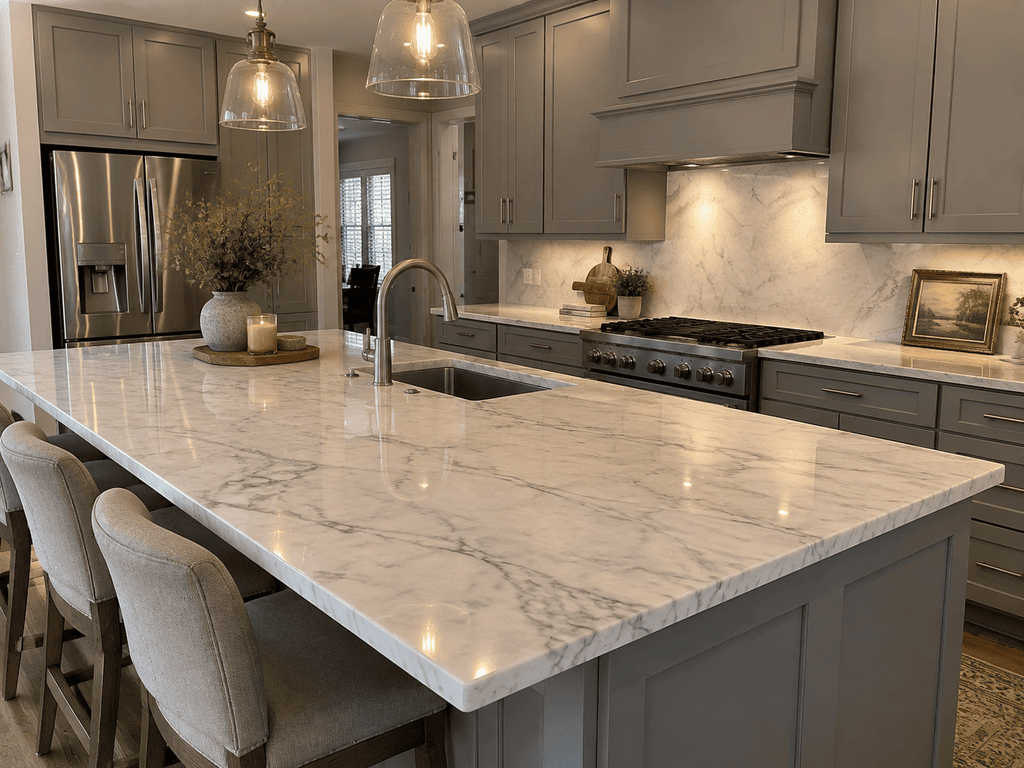
Common countertop marbles include Carrara, Calacatta, and Statuario. Carrara is generally known for a softer white-to-gray background with fine gray veining, while Calacatta often has a brighter background and more pronounced veins. Statuario can offer a white base with stronger gray or warmer veining.
The first practical decision is not the edge profile or sink cutout. It is the actual slab. Granite Empire of Huntsville recommends looking at the full slab whenever possible because a small sample cannot show how the veining will move across a long island, backsplash, or vanity.
How is a marble block turned into a slab?
A marble block is quarried, transported, and sawn into large slabs using specialized industrial equipment. The slabs are then calibrated, finished, inspected, and prepared for fabrication.
Large quarry blocks are cut with diamond tooling into slabs of a controlled thickness. The slabs may be polished to create a reflective surface, honed for a softer matte appearance, or finished using other techniques depending on the stone and application.
After production, each slab is inspected for natural characteristics. Small fissures, mineral deposits, color shifts, and variations are not automatically defects; they are part of what makes natural marble different from an engineered surface.
This is also why two slabs of the same marble name can look noticeably different. Natural stone is geological material, so the exact pattern cannot be reproduced from one piece to another.
How do we turn a marble slab into a custom countertop?
A custom marble countertop is made from a measured template rather than a generic factory size. Our team uses the actual cabinet layout, wall conditions, sink dimensions, appliance locations, and overhang requirements to create the cutting plan.
For marble countertops in Winchester, TN, this step is especially important when a kitchen has corners, angled walls, an oversized island, or an unusual sink configuration. A precise template helps us position the stone efficiently and plan seams and cutouts before the slab reaches the fabrication stage.
The cutting itself can involve CNC machinery, bridge saws, waterjet equipment, and hand finishing. Openings for sinks, cooktops, faucets, outlets, and other fixtures are cut according to the approved template.
The result is a countertop made specifically for that room rather than a standard piece of stone simply placed on top of the cabinets.
How are marble edges and seams finished?
Edges are shaped and polished after the main pieces are cut. Common profiles include eased, pencil, bevel, and more decorative profiles, although the best choice depends on the room, slab thickness, and overall design.
A seam is also part of fabrication, not an afterthought. We place seams where the layout allows and work to keep them visually controlled, while recognizing that natural stone patterns can make some seams more noticeable than others.
A straightforward vanity may require relatively simple fabrication. A large kitchen with several corners, sink cutouts, an island, and a full-height backsplash requires much more planning.
How long does marble countertop fabrication take?
A typical project can take about 5-7 business days from final template to installation when the selected slab is available and the project does not require unusual fabrication. The overall schedule can be longer when a slab has to be sourced, special edge work is requested, or other construction work needs to be completed first.
For marble countertops in Winchester, TN, we coordinate the fabrication schedule around the approved measurements and material availability. We do not treat installation as simply delivering a piece of stone; the countertop needs to be checked, finished, transported, and installed carefully.
The exact timeline should always be confirmed before fabrication begins because material availability and project complexity can change the schedule.
How much do marble countertops cost?
A reasonable planning range for marble is about $50-$90 per square foot for the slab material, with fabrication and installation commonly adding roughly $30-$60 per square foot depending on the project. That puts many installed projects in a broad range of about $80-$150 per square foot before unusual extras.
For example, a 50-square-foot countertop might have approximately $2,500-$4,500 in slab material and another $1,500-$3,000 in fabrication and installation. Sink cutouts, upgraded edges, backsplash pieces, difficult access, seams, and specialty materials can change the final number.
Sales periods can also affect material pricing and project budgeting. We sometimes see promotions tied to selected materials, showroom inventory, or limited-time sales, so it is worth asking about current offers before choosing a slab rather than assuming every marble carries the same price.
These numbers are planning ranges, not fixed quotes. The final price depends on the selected stone, slab size, fabrication requirements, installation conditions, and the amount of material required.
Is marble harder to maintain than quartz?
Marble generally requires more care than quartz because it is a natural calcium-based stone that can react with acids and can absorb staining liquids if it is not properly protected. Quartz is engineered and usually offers more consistent color and lower routine maintenance.
For homeowners comparing marble countertops in Winchester, TN, the right choice depends on how the kitchen is used. Marble can develop a patina and subtle etching over time, which some homeowners consider part of its character, while others prefer a surface that keeps a more uniform appearance.
| Feature | Marble | Quartz |
|---|---|---|
| Material | Natural stone | Engineered stone |
| Appearance | Natural variation and veining | Consistent patterns with many designs |
| Maintenance | Requires more care | Generally easier |
| Acid sensitivity | Can etch | Generally more resistant to household acids |
| Heat | Good heat tolerance, but protection is recommended | Heat can damage resin-based surfaces; trivets are recommended |
| Typical planning cost | About $80-$150/sq. ft. installed | Often about $60-$120/sq. ft. installed |
| Long-term look | Can develop natural patina | Usually remains more uniform |
The comparison is not about one material being universally better. Marble is often selected for its natural appearance and character, while quartz is often selected for consistency and easier routine maintenance.
What should homeowners inspect before ordering a marble slab?
Homeowners should inspect the actual slab for color, veining, fissures, filled areas, and overall pattern before approving fabrication. Photos and small samples are useful for narrowing choices, but the full slab is the better reference for a major countertop.
We also recommend checking how the slab will be laid out on the cabinets. A dramatic vein that looks excellent in one section can land directly through a sink or cooktop cutout if the layout is not planned carefully.
When we work on marble countertops in Winchester, TN, we pay attention to the relationship between the slab and the finished room. The goal is not simply to cut stone to fit; it is to make the natural pattern work with the cabinet layout and the features that will remain visible.
What custom work can be done with marble?
Marble can be customized far beyond a basic rectangular countertop. We can plan sink cutouts, cooktop openings, backsplashes, waterfall edges, islands, vanity tops, window sills, and other pieces around the dimensions of the project.
Complex layouts are where templating and slab planning become particularly valuable. An L-shaped kitchen, tight corner, furniture-style vanity, or oversized island may require multiple pieces and careful seam placement.
Our work on marble countertops in Winchester, TN can also include matching or coordinating pieces when the slab allows it. The exact result depends on slab size, pattern direction, and how much material the project requires.
How should homeowners care for marble after installation?
Marble should be cleaned with products appropriate for natural stone and protected according to the fabricator’s recommendations. Acidic cleaners, harsh chemicals, and abrasive products can dull or etch the surface.
Spills should be wiped up promptly, especially acidic liquids such as lemon juice, vinegar, wine, or tomato-based foods. Sealing can help reduce staining risk, but it does not make marble completely stain-proof or etch-proof.
For marble countertops in Winchester, TN, we encourage homeowners to think of maintenance as simple routine care rather than trying to make the stone behave like a different material. Marble is chosen partly because its natural surface can change subtly with use.
What does the installation process actually look like?
Installation usually begins after the fabricated pieces are inspected and prepared for delivery. The pieces are positioned on the cabinets, leveled, joined where necessary, secured, and finished around sinks, walls, and other connection points.
A standard project can often move from final template to installation in 5-7 business days when the material and fabrication schedule line up. More complicated projects may require additional time, particularly when there are several seams, large slabs, difficult access, or specialty finishing.
For marble countertops in Winchester, TN, our installation planning also accounts for transportation from our Huntsville showroom. Granite Empire of Huntsville serves customers in Winchester, TN, but our showroom is located only in Huntsville, AL; we do not have a separate office or showroom in Winchester.
What should you ask before approving the final countertop?
Ask which exact slab will be fabricated, how the slab will be laid out, where seams will fall, what edge profile is included, what sink cutouts are required, and what the expected installation date is. Those questions can prevent expensive surprises after fabrication begins.
It is also worth asking what is included in the quoted price. Granite Empire of Huntsville can review material, fabrication, installation, and project-specific details so homeowners understand what they are paying for before the order is finalized.
For homeowners researching marble countertops, the most useful comparison is the actual project scope rather than a single price per square foot. Two countertops with the same material can have very different costs because of layout, fabrication, access, and finishing requirements.

Frequently Asked Questions About Marble Countertops
Is marble a good choice for a kitchen countertop?
Yes, marble can be an excellent kitchen surface if you are comfortable with natural variation, etching, and routine care. Its appearance is one of its biggest advantages, especially for homeowners who want genuine natural stone rather than a manufactured pattern.
How often does marble need to be sealed?
Sealing frequency depends on the specific marble, sealer, usage, and manufacturer recommendations. A professional fabricator can tell you what protection is appropriate for the selected stone instead of applying a one-size-fits-all schedule.
Can hot pans be placed directly on marble?
Marble has good heat tolerance, but we still recommend using trivets or heat protection. Sudden or extreme temperature changes can damage stone or finishes, and protecting the surface is an easy precaution.
Does marble stain easily?
Marble can stain if spills penetrate the stone, particularly when the surface is not properly protected. Prompt cleanup and appropriate sealing reduce the risk, but no sealer makes natural marble completely stain-proof.
Can marble countertops be repaired if they chip?
Yes, many small chips and surface issues can be repaired, although the result depends on the size, location, color, and pattern of the stone. Larger damage may require more extensive fabrication or replacement.
How much does a marble countertop usually cost?
A practical starting budget is about $80-$150 per square foot installed, with the slab itself often around $50-$90 per square foot and fabrication and installation adding roughly $30-$60 per square foot. Specialty marble, complex layouts, premium edges, and difficult installations can cost more.
Can I see the slab before fabrication?
Yes, and we recommend it. Seeing the full slab gives you a much better idea of the actual color, movement, veining, and areas that can be used for the most visible parts of the project.
Granite Empire of Huntsville works with homeowners who want to understand the material before committing to fabrication. Our goal is to make the process straightforward: choose the stone, confirm the layout, approve the fabrication details, and install the finished countertop to the measurements of the room.
If you are considering a marble project in Winchester, TN, you can visit our Huntsville showroom to review available materials and discuss your project with our team. Granite Empire of Huntsville serves Winchester and surrounding areas while maintaining our showroom at one Huntsville location.
11104 Memorial Pkwy SW, Huntsville, AL 35803
256-832-9888