

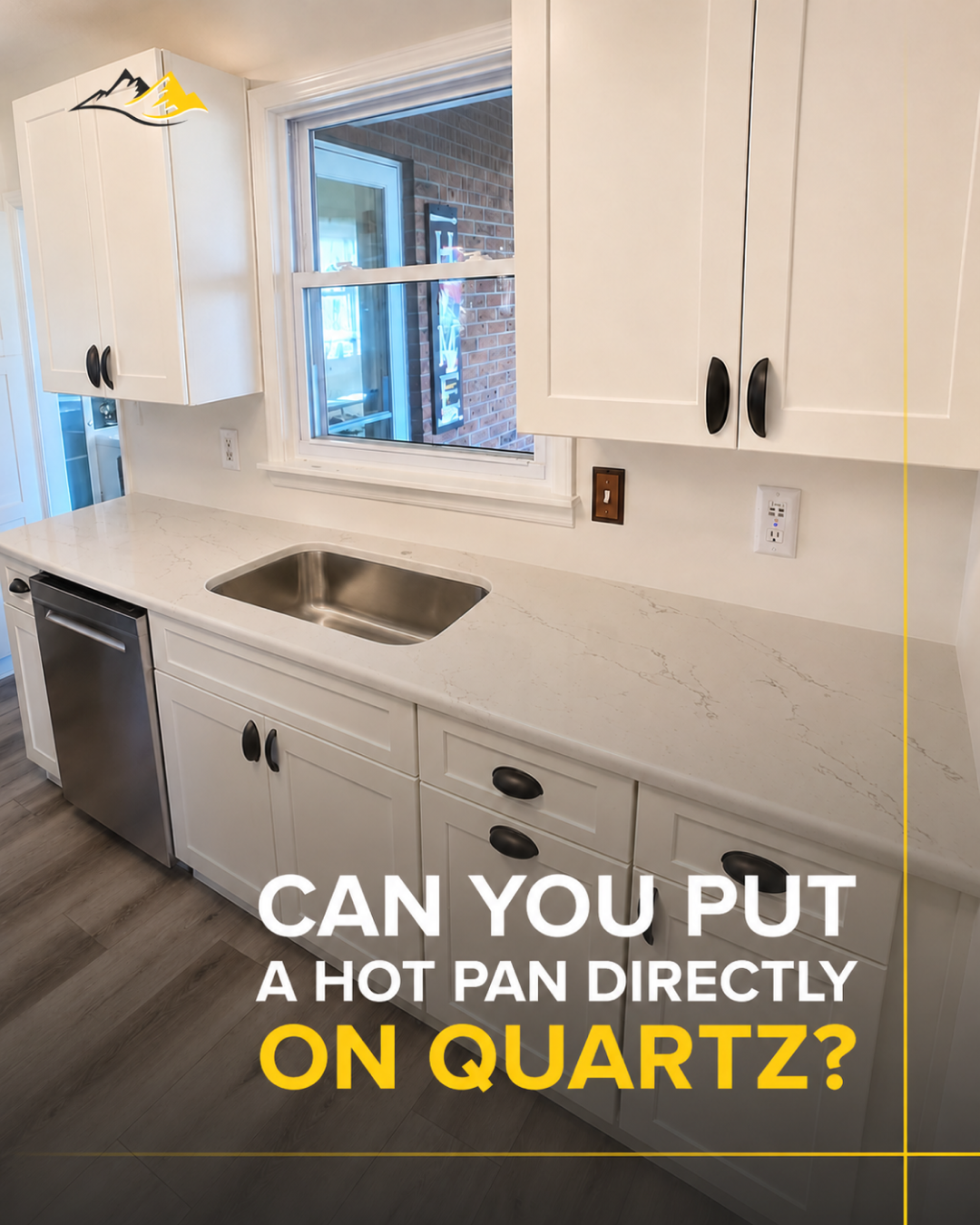
Quartz countertops are known for their stain resistance, consistent colors, and low maintenance. However, certain conditions can cause white or light-colored quartz to develop yellowish or brown discoloration over time.
At Granite Empire of Huntsville, we help homeowners understand what affects the appearance of engineered quartz and how to protect it. For those researching kitchen countertops Winchester, TN, the important distinction is between removable surface staining and permanent changes to the material.
Properly maintained indoor quartz can retain its original appearance for many years. The key is choosing a suitable product, protecting it from excessive heat and UV exposure, and following the manufacturer’s cleaning instructions.
What Causes Quartz Countertops to Turn Yellow?
Quartz countertops can develop yellow discoloration because of prolonged UV exposure, excessive heat, certain chemicals, or residue accumulating on the surface.
Engineered quartz is manufactured using mineral particles, binding resins, pigments, and other components. These materials create a dense, nonporous surface that resists everyday staining.
However, the binding materials and pigments can react to conditions outside their recommended use.
The most common causes include:
- UV exposure: Prolonged direct sunlight can cause discoloration in some quartz products.
- Excessive heat: Hot cookware or appliances can damage or discolor resin components.
- Chemical exposure: Strong cleaners and prolonged exposure to incompatible chemicals can alter the surface.
- Surface buildup: Cooking grease, soap residue, and cleaning products can create a yellowish film.
- Manufacturing differences: Formulations and product specifications vary between quartz brands and collections.
Not every yellow mark represents permanent damage. For homeowners evaluating kitchen countertops Winchester, TN, identifying the cause is the first step toward choosing an appropriate cleaning or repair solution.
Can Direct Sunlight Make White Quartz Turn Yellow?
Prolonged UV exposure can cause some engineered quartz surfaces to change color, particularly products not designed for outdoor use or intense sunlight.
This is one reason standard indoor quartz should not automatically be used for outdoor kitchens.
For example, Silestone advises against outdoor installation because ultraviolet radiation can damage its surfaces. Individual products may have different tolerances, so we recommend checking the manufacturer’s specifications.
In residential kitchens, the degree of exposure depends on window placement, orientation, shading, and the selected quartz formulation.
A countertop positioned beneath a large south-facing window may receive prolonged sunlight during the day. However, ordinary indoor daylight does not mean the surface will inevitably turn yellow.
At Granite Empire of Huntsville, we recommend considering natural light when selecting quartz for bright kitchens.
For homeowners comparing kitchen countertops Winchester, TN, we suggest looking at the actual room conditions before choosing a particular white or cream-colored slab.
Using blinds or shades during periods of intense sunlight can help reduce direct exposure. Homeowners should also confirm whether their chosen collection has specific UV-related limitations.
Can Hot Pans or Kitchen Appliances Cause Yellow Spots?
Excessive heat can discolor quartz because its binding resins are sensitive to high temperatures.
Quartz is heat-resistant under normal kitchen conditions, but it is not heatproof. Direct contact with hot cookware can cause discoloration or, in more severe situations, cracking.
We recommend paying particular attention to heat-producing appliances, including:
- Hot pans removed directly from the stove
- Air fryers and toaster ovens
- Electric griddles
- Slow cookers
- Other countertop appliances that release concentrated heat
A hot appliance positioned in the same place repeatedly may expose the underlying countertop to sustained temperatures.
Using trivets or manufacturer-recommended heat-resistant supports helps prevent damage.
A yellow or brown mark caused by heat may be permanent because the discoloration can occur within the surface material rather than on top of it.
Which Cleaning Products Can Cause Quartz Discoloration?
Strong or incompatible cleaning chemicals can damage quartz finishes and cause discoloration, especially when left on the surface for extended periods.
We recommend using mild dish soap, warm water, and a soft microfiber cloth for everyday cleaning.
Products to avoid unless specifically approved by the quartz manufacturer include concentrated bleach, oven cleaners, drain cleaners, paint removers, and abrasive cleaning powders.
Some manufacturers permit carefully controlled use of particular cleaning chemicals, while others explicitly prohibit them. For example, the approved cleaning procedures for Silestone and Cambria are not identical.
This distinction matters when maintaining kitchen countertops Winchester, TN, because a cleaning method recommended for one brand may damage another.
We also advise against using abrasive pads to remove stubborn marks without checking the manufacturer’s care instructions.
Repeated aggressive scrubbing can affect surface appearance without solving the underlying discoloration.
How Can You Tell the Difference Between a Stain and Permanent Yellowing?
Removable stains usually sit on the surface or result from accumulated residue, while permanent discoloration involves changes to the countertop material itself.
The location and appearance of the affected area often provide useful clues.
| Appearance | Possible Cause | Recommended First Step | Can It Be Removed? |
|---|---|---|---|
| Yellow film across a frequently used area | Grease or cleaning residue | Mild soap and warm water | Often |
| Yellowing concentrated near a sunny window | UV-related discoloration | Check product specifications | May be permanent |
| Brownish mark near a stove | Excessive heat | Professional assessment | Often permanent |
| Discolored patch after chemical exposure | Chemical reaction | Rinse and consult manufacturer | Depends on damage |
| Cloudy or dull surface | Cleaning residue or surface damage | Use approved cleaning method | Depends on cause |
This comparison helps determine whether the next step should be cleaning, manufacturer consultation, or professional assessment.
At Granite Empire of Huntsville, we recommend identifying the quartz brand and collection before attempting any treatment.
An aggressive chemical treatment can make a small cosmetic issue more noticeable or permanently damage the finish.
Can Yellow Quartz Countertops Be Restored to Their Original Color?
Some yellow marks can be removed, but permanent UV, heat, or chemical discoloration generally cannot be reversed through ordinary cleaning.
If the surface appears yellow because of grease or detergent buildup, start with a gentle cleaning method.
We recommend the following process:
- Remove loose debris with a soft cloth.
- Clean the area using warm water and mild dish soap.
- Wipe the surface with a clean, damp microfiber cloth.
- Remove remaining soap residue.
- Dry the countertop thoroughly and inspect the result.
If the discoloration remains, consult the manufacturer’s approved stain-removal instructions before using stronger products.
Unlike many natural stone surfaces, engineered quartz generally cannot be restored through conventional stone polishing methods without risking changes to its factory finish.
When discoloration is permanent and visually significant, replacing the affected countertop section may be the most practical solution.
We recommend professional evaluation before making that decision, particularly when the countertop is still covered by a manufacturer warranty.
Which Quartz Colors and Brands Are Worth Considering?
The best quartz color depends on the kitchen’s lighting, daily use, and desired appearance. No countertop color completely prevents damage from UV exposure, heat, or unsuitable cleaning chemicals.
However, certain patterns can make everyday residue or minor visual changes less noticeable.
For homeowners selecting kitchen countertops Winchester, TN, we recommend comparing light and patterned surfaces under realistic lighting conditions.
Popular quartz collections worth considering include:
- MSI Q Calacatta Laza: White background with prominent gray veining.
- Silestone Eternal Calacatta Gold: Light background with gray and warm gold veining.
- Caesarstone Frosty Carrina: Soft white appearance with subtle gray veining.
- Cambria Brittanicca Warm: Warm white surface with flowing, expressive veining.
These collections offer different visual styles, price points, and manufacturer-specific care requirements. Availability should be confirmed before ordering.
A bright white countertop can create a clean, modern appearance, while warmer ivory tones may coordinate more naturally with wood cabinetry and beige finishes.
We recommend evaluating the actual slab or representative product samples rather than relying entirely on online photographs.
How Can Homeowners Prevent Quartz Countertops From Turning Yellow?
Preventing quartz discoloration primarily involves controlling heat exposure, using approved cleaning products, and reducing prolonged direct UV exposure.
A few consistent habits can significantly reduce the risk of avoidable surface damage.
For homeowners installing kitchen countertops Winchester, TN, we suggest making the following practices part of everyday kitchen maintenance:
- Use trivets beneath hot cookware and heat-producing appliances.
- Clean spills promptly, particularly oils and strongly colored foods.
- Avoid leaving concentrated cleaning chemicals on the surface.
- Use soft cloths rather than abrasive scrubbing pads.
- Keep the countertop free from persistent grease or soap buildup.
- Follow the specific manufacturer’s maintenance instructions.
- Reduce intense direct sunlight where practical.
Quartz does not require routine sealing. Applying products intended for sealing natural granite or marble can leave unnecessary residue on engineered quartz.
We also recommend keeping the product information and warranty documents after installation.
Knowing the manufacturer and collection makes it easier to obtain accurate maintenance guidance if a problem develops years later.
How Much Do Quartz Kitchen Countertops Cost in 2026?
Quartz countertop pricing depends on the manufacturer, collection, slab size, fabrication requirements, and installation complexity.
Our published 2026 pricing guidance provides the following planning ranges:
| Cost Component | Typical Price |
|---|---|
| Entry-level quartz slab | $50–$70 per sq ft |
| Mid-range quartz slab | $70–$100 per sq ft |
| Premium quartz slab | $100–$140 per sq ft |
| Fabrication | $20–$40 per sq ft |
| Installation labor | $15–$35 per sq ft |
| Estimated installed quartz | $85–$180 per sq ft |
These are planning ranges, and the exact cost depends on the project. Installed pricing already includes the usual fabrication and installation components, so those charges should not be added twice.
For a kitchen requiring approximately 50–60 square feet of countertops, the resulting installed cost can range from about $4,250 to $10,800.
At Granite Empire of Huntsville, many mid-range quartz projects fall between $5,500 and $8,500, including standard templating, fabrication, a standard sink cutout, and installation.
Additional expenses may include removing existing countertops, complex edge profiles, additional cutouts, or specialized installation requirements.
When budgeting for kitchen countertops Winchester, TN, we recommend comparing complete written estimates rather than material prices alone.
The most expensive quartz is not automatically the best choice for every kitchen. Matching the product’s specifications to the intended use is more important than selecting a slab solely because it belongs to a premium collection.

How Long Does Quartz Countertop Fabrication and Installation Take?
Our standard timeline is 5–7 business days from completed templating to installation, assuming the selected quartz is in stock and the cabinets are ready.
At Granite Empire of Huntsville, we coordinate measurements, fabrication, edge finishing, sink and appliance cutouts, and final installation.
The overall process from initial material selection to completed countertops commonly takes approximately 10–14 business days when the project is ready to proceed.
During templating, we verify cabinet dimensions, countertop overhangs, seams, and appliance openings.
We also confirm that the cabinets are level and structurally suitable for the selected material.
Installation itself generally takes one day for a standard kitchen, although larger or more complex projects may require additional time.
Our only showroom is in Huntsville, AL. We serve Winchester, TN and surrounding communities through scheduled templating and installation visits, but we do not operate a separate office or showroom in Winchester.
FAQ
1. Do All White Quartz Countertops Eventually Turn Yellow?
No. Yellowing is not an inevitable part of quartz aging. Product formulation, UV exposure, heat, chemical contact, and maintenance affect the risk of discoloration.
2. Can Sunlight Through Kitchen Windows Damage Quartz?
Prolonged direct sunlight can affect some indoor quartz products. The actual risk depends on the brand, formulation, window conditions, and duration of exposure.
3. Can Bleach Remove Yellow Stains From Quartz?
Bleach is not a universal solution and can permanently damage certain quartz products. We recommend following the specific manufacturer’s cleaning instructions rather than applying bleach without checking compatibility.
4. Does Quartz Need Sealing to Prevent Yellowing?
No. Engineered quartz is nonporous and does not require routine sealing. Sealing will not prevent UV-related or heat-related discoloration.
5. Can Heat-Related Yellow Marks Be Repaired?
Heat-related discoloration is often permanent because the binding materials may have been damaged. Professional evaluation can determine whether cosmetic repair or replacement is appropriate.
6. Is Quartz Better Than Marble for Avoiding Stains?
Quartz is generally more resistant to everyday staining because its nonporous surface does not require sealing. Marble is porous and can also develop etching from acidic substances.
7. Where Can I Find Quartz Countertops Near Winchester, TN?
Homeowners searching for kitchen countertops Winchester, TN can work with our Huntsville-based team for quartz selection, templating, fabrication, and installation. We serve Winchester from our Huntsville location and can provide a project-specific estimate.
Where Can You Find the Right Quartz Countertops for Your Kitchen?
Quartz can remain attractive for many years when homeowners choose the right product and follow appropriate care practices. At Granite Empire of Huntsville, we help customers compare quartz collections, understand maintenance requirements, and select materials that suit their kitchens and budgets. We serve Winchester, TN and the surrounding Tennessee Valley from our showroom at 11104 Memorial Pkwy SW, Huntsville, AL 35803. Visit us to compare available options or call 256-832-9888 to discuss your project and receive an estimate based on your layout, preferred material, and installation requirements.