

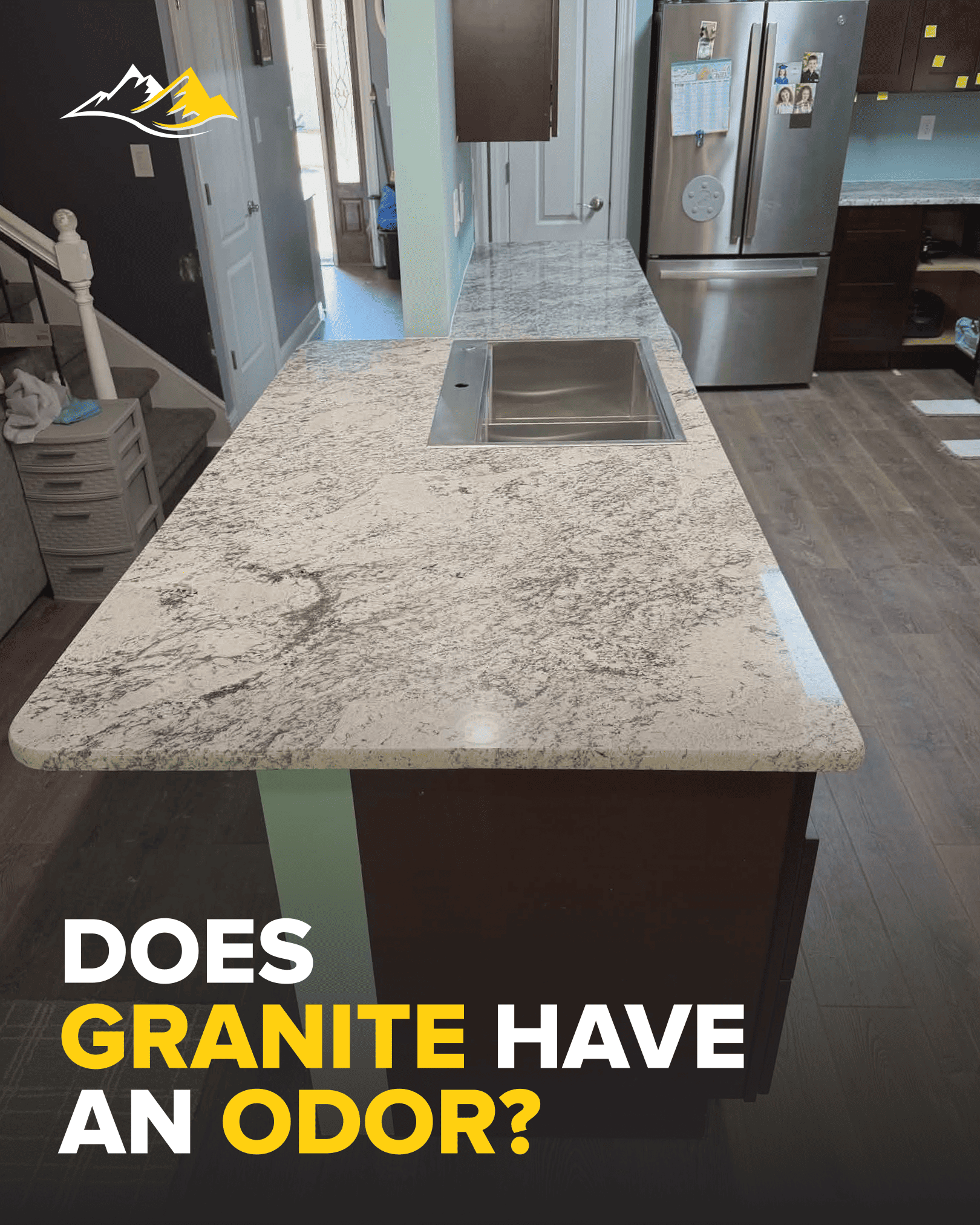
It’s a question we don’t hear every single day, but when it comes up, it’s always worth taking seriously. Homeowners who are investing in granite kitchen countertops want to know exactly what they’re getting — not just how the surface looks or how long it lasts, but how it behaves in the real environment of a working kitchen. And odor is a legitimate concern. Nobody wants to spend good money on a beautiful kitchen upgrade only to notice an unexpected smell coming from the countertop surface.
At Granite Empire of Huntsville, we’ve been helping homeowners navigate questions like this for years. We’re based in Huntsville, AL — that’s where our showroom, fabrication facility, and installation team all operate from, and it’s our only location. We proudly serve customers throughout the surrounding region, including the many homeowners from Hartselle, AL who make the trip to our Huntsville showroom when they’re ready to invest in granite kitchen countertops in Hartselle, AL. So let’s answer this question fully and honestly, the way we would if you were sitting across from us right now.

The Short Answer: Natural Granite Is Essentially Odorless
Let’s start with the most reassuring part of this conversation. Pure, natural granite is a dense igneous rock composed primarily of minerals like quartz, feldspar, and mica. In its natural state, granite has no inherent odor. It doesn’t off-gas, it doesn’t emit volatile compounds, and it doesn’t have any biological material that would produce a smell over time. The stone itself is completely inert from an odor standpoint.
This is one of the reasons granite kitchen countertops in Hartselle, AL are such a popular choice for homeowners who are thinking carefully about the materials in their home environment. Granite doesn’t contribute to indoor air quality concerns the way some synthetic materials can, and it has a long track record of safe, odor-free use in kitchens around the world.
So if granite itself doesn’t smell, why do some homeowners occasionally report noticing an odor after installation? The answer lies not in the stone but in the materials and processes that surround it — and understanding those distinctions gives you a complete and accurate picture of what to expect.
New Installation Smell: What’s Actually Causing It
If you’ve ever noticed a smell after having granite kitchen countertops installed, the most likely source is the adhesives, sealers, epoxies, or caulking compounds used during the installation process rather than the granite itself. These are standard materials used by countertop installers across the industry, and most of them have a detectable odor during and immediately after application.
Silicone caulk, which is used to seal the joint between the countertop and the wall or backsplash, has a characteristic smell that most homeowners recognize — a slightly sharp, vinegary odor that comes from the acetic acid released as the silicone cures. This is completely normal and dissipates fully within a day or two as the caulk finishes curing and the ventilation in your kitchen does its job.
Epoxy is used in countertop fabrication and installation to fill natural voids in the stone and to bond pieces together at seams. During the curing process, some epoxies release a mild chemical odor. Again, this is temporary and typically resolves within the first 24 to 48 hours after installation.
The sealer applied to granite kitchen countertops in Hartselle, AL at the time of installation can also have a noticeable smell initially. Most professional-grade sealers are solvent-based, and those solvents do carry an odor while they’re evaporating into the surface. Once the sealer has fully penetrated and cured — which usually takes anywhere from a few hours to a full day depending on the product — the smell is gone and the surface is completely inert.
At Granite Empire of Huntsville, we always let customers know what to expect in the hours following installation. Good ventilation — opening windows, running your kitchen exhaust fan — goes a long way toward clearing any installation-related odors quickly. By the time you’re cooking your first meal on your new countertops, any smell from the installation process is typically long gone.
What About Odors That Develop Over Time?
This is where the conversation gets a little more nuanced, and where the importance of proper sealing and maintenance becomes very clear. While granite itself is odorless, it is a porous natural stone — meaning it has microscopic pores that can absorb liquids and organic material if the surface is not properly sealed and maintained.
When those pores are left unprotected, kitchen liquids like cooking oils, meat juices, wine, and other organic substances can penetrate the surface and begin to break down inside the stone. Over time, this biological activity can produce odors that seem to come from the countertop itself but are actually originating from material that has been absorbed into an inadequately sealed surface.
This is not a flaw in granite as a material — it’s a maintenance issue that is entirely preventable. Properly sealed granite kitchen countertops in Hartselle, AL do not absorb liquids in any meaningful quantity under normal conditions, and a well-maintained surface will never develop this kind of odor issue. The key is consistent attention to the sealer — applying it at installation and resealing on the appropriate schedule based on the specific stone and the level of use it receives.
At Granite Empire of Huntsville, we apply a professional-grade sealer to every countertop we install as a standard part of our installation process. We also take time to explain the resealing schedule to every customer so they know exactly what to do and when to do it. For homeowners with granite kitchen countertops in Hartselle, AL who aren’t sure whether their countertop is properly sealed, the water bead test is a simple and reliable way to check: pour a small amount of water on the surface and watch what happens. If it beads up and sits on top, the seal is doing its job. If it soaks in relatively quickly, it’s time to reseal.
Bacteria and Hygiene: Separating Fact From Fiction
Some of the concern around countertop odors is tied to broader questions about bacteria and food safety in the kitchen. It’s worth addressing this directly because there has been a lot of conflicting information circulating over the years about whether granite harbors bacteria and what that means for kitchen hygiene.
The reality is that properly sealed granite is a very hygienic surface for food preparation. The sealer closes off the pores that would otherwise provide an environment for bacteria to take hold, and the smooth, hard surface of granite doesn’t provide the kind of physical texture that traps food particles the way some other materials can. Studies on granite and food safety have generally found that properly maintained granite performs well as a kitchen surface from a hygiene standpoint.
Problems arise, as mentioned above, when the seal has deteriorated and the stone’s pores are exposed. In that condition, organic material can be absorbed and bacteria can potentially grow within the stone, which is both a hygiene concern and a potential source of odor. This is another reason why we emphasize the maintenance relationship so strongly with every customer who invests in granite kitchen countertops in Hartselle, AL through our team.
Routine daily cleaning with mild soap and warm water is all that’s needed to keep a properly sealed granite surface clean and hygienic. Avoid harsh chemicals like bleach or acidic cleaners, which can degrade the sealer over time and leave the stone more vulnerable to absorption.
What About Radon? Addressing a Common Concern
Some homeowners have come across information suggesting that granite countertops might emit radon gas, and we want to address that concern directly because it deserves a clear and honest answer. Granite, like many natural materials, does contain trace amounts of uranium and other naturally occurring radioactive minerals. These minerals can produce radon as they decay.
However, the scientific consensus — supported by research from organizations including the Environmental Protection Agency and numerous independent studies — is that the amount of radon potentially emitted by granite countertops is so small as to be negligible in terms of meaningful health risk. The radon levels associated with granite countertops are well within normal background radiation ranges and are not considered a health concern for homeowners.
At Granite Empire of Huntsville, we believe in giving customers accurate, evidence-based information rather than dismissing concerns or amplifying fears that aren’t warranted. If this is a topic you want to discuss in more detail, our team is always happy to have that conversation openly.

The Bottom Line on Granite and Odor
Granite kitchen countertops are not a source of odor under normal conditions. The stone itself is completely inert and odorless. Any smell noticed immediately after installation comes from the caulks, adhesives, and sealers used in the installation process and dissipates quickly. Any odor that develops on an older granite countertop is almost always a maintenance issue — specifically, a sealer that has expired and allowed organic material to be absorbed into the stone — and is entirely preventable with proper care.
For homeowners in Hartselle, AL considering granite kitchen countertops in Hartselle, AL, this is genuinely good news. You’re looking at a material with an exceptional track record of safe, clean, odor-free performance in kitchens across every climate, lifestyle, and cooking style imaginable. When the material is properly installed and properly maintained, odor simply isn’t a concern you need to carry.
Granite Empire of Huntsville is proud to serve the Hartselle, AL community from our Huntsville, AL home base. We don’t have a location in Hartselle — everything we do happens out of our single Huntsville facility — but the homeowners in that community are among the customers we value most, and we approach every project we do there with the same care, honesty, and craftsmanship we put into every job. If you have questions about granite kitchen countertops in Hartselle, AL or want to come in and see our slab selection in person, we’d love to welcome you to our showroom. Great countertops start with great information, and we’re here to provide both.