

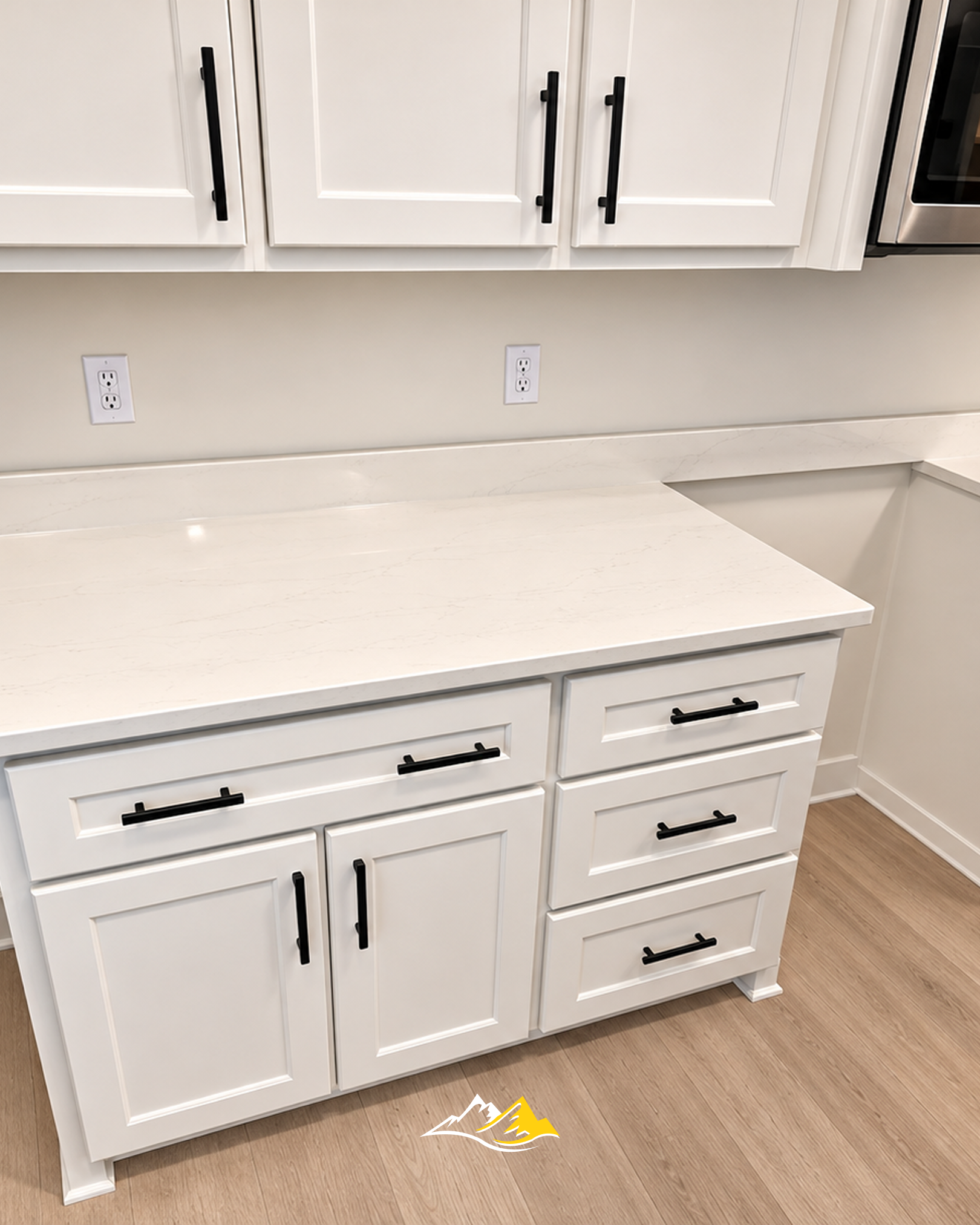
A countertop may look spotless immediately after cleaning yet develop dull patches, stubborn marks, or a damaged finish over time. Often the culprit is an unsuitable cleaner or scrubbing method.
At Granite Empire of Huntsville, we help homeowners understand how granite, marble, quartzite, and engineered quartz behave in everyday kitchens. People searching for countertop installers Winchester, TN often focus on appearance and price first, but the right maintenance routine matters just as much once the kitchen is in use.

What Actually Happens When You Use the Wrong Countertop Cleaner?
The wrong cleaner can affect a countertop in several different ways: it may damage the finish, weaken stain protection, leave residue, or react with minerals in the stone. Identifying the problem helps you choose the right response.
Marble contains calcium carbonate, which reacts with acids. Even a small amount of vinegar or lemon juice can leave a pale, dull area called an etch mark. That mark is physical damage to the polished surface, not dirt that needs stronger scrubbing.
Granite and many quartzites are more resistant to household acids, but that does not make every cleaner safe. Repeated exposure to aggressive products can affect a sealer or certain minerals within a slab. Engineered quartz has different vulnerabilities because its surface includes binding materials that can be damaged by harsh chemicals or high heat.
A single all-purpose cleaner can cause avoidable damage.
Do Granite, Marble, Quartzite, and Quartz Need Different Cleaning Methods?
Each material needs a slightly different approach. For homeowners comparing countertop installers Winchester, TN, we recommend considering the cleaning routine alongside color, edge profile, and expected kitchen use.
| Material | Safe everyday care | Main cleaning risk | Sealing requirements |
|---|---|---|---|
| Granite | Soft cloth, warm water, mild soap or pH-neutral stone cleaner | Abrasives, incompatible chemicals, stains if unprotected | Depends on the stone and existing treatment |
| Marble | Soft cloth and pH-neutral stone cleaner | Vinegar, lemon, acidic cleaners, abrasive scrubbing | Often beneficial for stain resistance; does not prevent etching |
| Quartzite | Gentle cleaner approved for natural stone | Harsh chemicals; variable mineral composition and porosity | Evaluate the individual slab and finish |
| Engineered quartz | Warm water, mild soap, nonabrasive cloth | Strong chemicals, solvents, abrasive pads | Generally does not require sealing |
Carrara marble requires care around acidic foods; Black Pearl granite is generally practical for daily kitchens; and Taj Mahal quartzite needs care suited to its particular slab. For Cambria, Caesarstone, and MSI Q, follow the brand instructions because approved products differ.
At Granite Empire of Huntsville, we would rather help customers choose a surface that matches their habits than suggest one generic cleaning rule for every stone.
Why Can Vinegar, Lemon Juice, and Bathroom Cleaners Be Harmful?
Acidic cleaners are especially risky on marble and other calcium-based stones because they can etch the surface. Vinegar may be useful elsewhere in the home, but it is not a universal countertop cleaner.
People researching countertop installers Winchester, TN should know that bathroom descalers, rust removers, and toilet-bowl products can be even more aggressive. Some contain chemicals that affect natural stone, including minerals found in otherwise durable granite and quartzite. “Natural” on a label does not guarantee stone safety.
Avoid homemade mixtures. Combining cleaners can create toxic fumes, while a tile-cleaning recipe might damage stone. Choose a pH-neutral cleaner approved for your countertop.
Can Bleach, Disinfectants, or Abrasive Sponges Ruin a Finish?
Bleach, strong degreasers, oven cleaners, and abrasive pads should not be treated as routine countertop products. Depending on the product and exposure, they can cause discoloration, dullness, or damage to protective treatments.
For example, Cambria advises against bleach, oven cleaners, and abrasive scouring products on its quartz surfaces. Different quartz brands have different approved products.
Rough green or metal scrub pads can also create fine scratches or dull spots. If dried food will not wipe away, soften it with warm water rather than applying more pressure. For customers asking countertop installers Winchester, TN about long-term durability, this simple change is often more useful than buying a stronger cleaning product.
What Is the Safest Daily Countertop Cleaning Routine?
For most countertops, gentle cleaning is the best starting point: remove crumbs, wipe with a soft cloth and warm water, use a small amount of mild soap or an approved neutral cleaner, rinse, and dry. Drying helps prevent visible water spots and leftover soap film.
A practical routine looks like this:
- Wipe up coffee, wine, oil, citrus juice, and sauces promptly rather than letting them sit.
- Use a clean microfiber cloth or soft, nonabrasive sponge.
- Apply a cleaner approved for the exact stone or quartz brand.
- Rinse away detergent residue and dry with another clean cloth.
- Use cutting boards and trivets to reduce damage unrelated to cleaning.
At Granite Empire of Huntsville, we suggest keeping a labeled, countertop-safe cleaner under the sink to prevent mix-ups.
When homeowners contact us after searching for countertop installers Winchester, TN, we also ask how the household uses the kitchen. A busy family cooking several times a day may prefer a different surface and care routine from someone who mostly prepares light meals.
How Should You Handle Coffee, Oil, Hard-Water Marks, and Stubborn Stains?
Identify the mark before scrubbing. A stain is absorbed or deposited material; an etch changes the finish. Soap film and mineral deposits need different treatment.
For fresh coffee or cooking oil, blot the spill, clean gently with an approved product, rinse, and dry. If a mark remains, avoid experimenting with bleach, vinegar, or homemade pastes. Deeper stains sometimes require a material-specific poultice or professional treatment.
Hard-water spots around faucets may be mineral deposits on top of the countertop. Acidic descalers can remove deposits but also harm nearby marble, so the correct remover must be approved for the surface. On engineered quartz, follow the product maker’s guidance for persistent marks rather than borrowing a technique intended for granite.
Granite Empire of Huntsville can help customers identify the type of material they purchased and determine whether a care issue should be referred to a stone-care specialist.

Can a Countertop Damaged by Cleaning Be Repaired?
Some cleaning damage can be corrected, but the solution depends on what actually happened. Soap film may wash away; an etched marble finish may need professional honing or polishing; a deeply discolored engineered-quartz surface can be more difficult to restore.
Do not polish a small spot without knowing the finish and material. A do-it-yourself polishing compound may create a shiny patch surrounded by a honed surface, or make the original problem more noticeable.
If damage appears, photograph it in natural light, record the product used, and stop applying chemicals. Homeowners comparing countertop installers Winchester, TN should ask about care instructions and the process for getting professional advice, not just the installation date.
Should Maintenance Influence Your Countertop Budget and Installation Plan?
Maintenance should be part of the buying decision, especially when two stones look similar but behave differently. A lower-maintenance choice may be worth considering if you cook frequently, have children helping with cleanup, or prefer not to monitor acidic spills closely.
For budgeting, granite slab material commonly falls around $50–$90 per square foot, with installation fees starting around $35 per square foot. These are planning figures, not a fixed installed price. Slab selection, layout, cutouts, edge details, and site conditions affect the final quote; other materials and specialty designs may price differently.
For in-stock materials and a kitchen ready for templating, a typical schedule can be 5–7 business days from template to installation. Special-order slabs, complex fabrication, or unfinished cabinets may extend that timeframe. We confirm timing before work begins.
Granite Empire of Huntsville serves homeowners in Winchester, TN, but our only showroom is in Huntsville, Alabama; we do not have an office or showroom in Winchester. If you are researching countertop installers Winchester, TN, visit us in Huntsville to discuss materials and care requirements.
Frequently Asked Questions About Countertop Cleaning
Can I use dish soap on granite countertops?
A small amount of mild dish soap mixed with warm water is generally suitable for routine granite cleaning. Rinse thoroughly and dry the surface so soap residue does not build up and create streaks.
Does vinegar permanently damage marble?
Vinegar can etch marble because the acid reacts with calcium-containing minerals. The resulting dull spot may require professional refinishing; ordinary cleaning will not reverse the chemical change.
Can I use disinfecting wipes on quartz countertops?
Only if the specific quartz manufacturer approves the product and its directions. Some wipes contain chemicals or leave residues that are not recommended for certain engineered-quartz surfaces.
How often should granite be sealed?
There is no single schedule for every granite countertop. The stone’s absorption characteristics, existing sealer, and use determine whether resealing is necessary, so follow the fabricator’s or sealer manufacturer’s recommendations.
Will baking soda remove stubborn countertop stains?
Not universally. Baking soda is mildly abrasive, and a homemade paste may alter certain finishes; use a brand-approved method or consult a stone-care professional before treating a persistent mark.
Is quartz more resistant to cleaning chemicals than natural stone?
Not in every situation. Engineered quartz resists absorption and generally needs no sealer, but its binders can be vulnerable to strong chemicals; marble is particularly sensitive to acids, while granite and quartzite have their own material-specific concerns.
What should I ask before choosing a new countertop?
Ask which cleaners are approved, whether sealing is recommended, how the finish handles common spills, and what to do if a mark appears. Homeowners searching for countertop installers Winchester, TN should also confirm the exact product, final installed quote, and realistic project timing.
A countertop that looks good years after installation usually benefits from simple, consistent care rather than aggressive cleaning. At Granite Empire of Huntsville, we help homeowners choose materials they can maintain confidently and understand what daily use will require. Visit our Huntsville showroom at 11104 Memorial Pkwy SW, Huntsville, AL 35803, or call 256-832-9888 to discuss your kitchen project and the care routine that makes sense for it.